

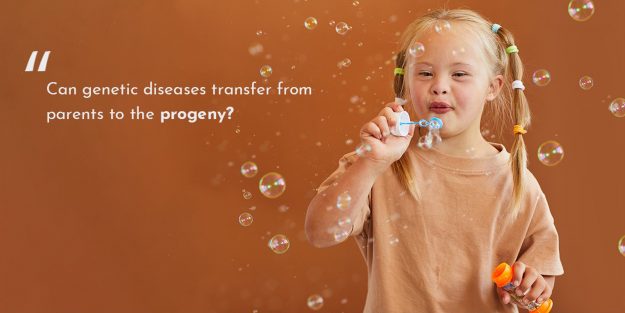
Can genetic diseases transfer from parents to the progeny?
09 Mar 2022
The birth of a newborn brings happiness and a smile to the face of parents. Most of the babies are born healthy, while some babies are born with serious but treatable medical conditions if diagnosed early. Can genetic diseases transfer from parents to the progeny? This is one of the most commonly asked questions from many parents. The answer to this is yes, there is a probability of transferring such diseases from affected parents to their children. If parents are a carrier of any diseases or concerns they must take the help of a doctor and also go for several tests both before and after the birth of the baby to make their little one's future healthy and secure. Read on to know more about genetic diseases and tests that can diagnose these conditions. There is a great likelihood of inheriting genetic diseases (passing it down from the parents to the offspring) if the parent is a carrier of the disease (have one or more of their genes altered/mutated) whether or not they show symptoms of the disease. A child can develop a hereditary disease if there is a genetic error during the formation of the fetus. In other words, there is an alteration of genes spotted in the germline cells (sperms or eggs) of the affected person (biological parent). Genetic diseases can be transferred from parents to the progeny in different patterns:
- Autosomal dominant- For individuals suffering from autosomal dominant disorders like Marfan’s syndrome and Huntington's disease, there is a 50% chance of the child having the same condition.
- Autosomal recessive- For parents who are not diseased but carry a single copy of each of the altered genes then there is only a 25% chance of the child being affected. If only one parent is a carrier, no child will develop the disorder. Examples of such an inheritance pattern are sickle cell disease and cystic fibrosis.
- X-linked dominant- Inheritance of X-linked dominant conditions (such as Fragile X syndrome) differs in males and females as women have both X chromosomes and men have one Y and one X chromosome. A man will pass his X chromosomes to all of his daughters and Y chromosomes to his sons while a woman transfers her X chromosomes to each of her children. Therefore, the daughters of men having this condition will only be affected and there will be a 50% chance of inheriting the condition in the son or daughter of an affected woman.
- X-linked recessive- In such a case, the sons of men affected with this condition will not be affected and the daughters will carry only one altered gene copy while there is a 50% probability of having sons affected and 50% of a daughter becoming a carrier in a woman affected by X-linked recessive condition. Examples of such genetic diseases include Fabry disease and Hemophilia.
- Y-linked- The Y-linked diseases pass on from affected male parents to all of his sons. Examples include Hypertrichosis of the ears, porcupine man, and webbed toes.