

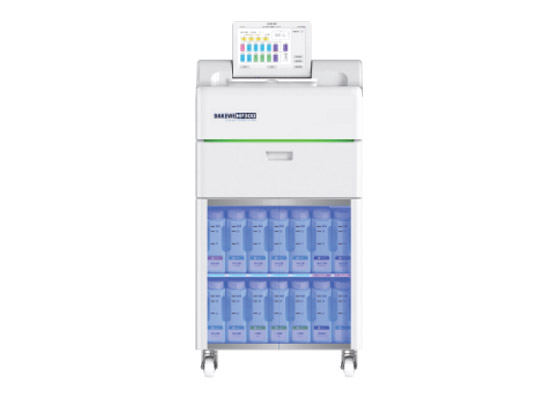
Overview
The HP300 Automatic Tissue Processor is designed to deliver efficient, reliable, and well-controlled tissue processing for laboratories. With intelligent monitoring systems, advanced temperature control, and automated safety mechanisms, the system ensures consistent processing results while reducing the risk of operational errors. The instrument integrates real-time monitoring, smart diagnostics, and multi-dimensional reagent management to improve workflow efficiency and instrument uptime. Its user-friendly design, including a large adjustable touch screen and organized reagent system, makes it suitable for high-throughput laboratory environments.
Key Features
- 12.1-inch LCD touch screen with 3 adjustable viewing angles for convenient operation.
- Electric retort lock ensures safe and secure operation during tissue processing.
- Heated retort lid with Teflon coating reduces paraffin residue and simplifies cleaning.
- Heat-retaining marble benchtop provides durability and easy cleaning.
- Real-time status light displays the current operating status of the instrument.
- 4 wax tanks support efficient tissue processing.
- Reagent bottle system includes 10 reagent bottles, 3 cleaning reagent bottles, and 1 condensate bottle.
- Back-lit cabinet improves visibility for monitoring reagents.
- Bottle connection check ensures correct bottle installation and prevents operational errors.
Technical Specifications
- Process capacity: Up to 300 cassettes in 2 large baskets, or 280 in 4 small baskets.
- Wax tanks: 3 × 4.2 L, 1 × 5.6 L.
- Reagent bottles: 10 reagent bottles, 3 cleaning reagent bottles, 1 condensate bottle.
- Program memory: Up to 100 programs.
- Level sensors: 3 ultrasonic level sensors.
- Screen: 12.1 inch LCD color touch screen, 3 angles adjustable.
- Data interface: USB, LAN.
- Power: 100–120 VAC, 60 Hz or 220–240 VAC, 50/60 Hz; 1200 VA.
- Dimensions (W×D×H): 620 × 640 × 1170 mm.
- Weight: Approx. 180 kg, without reagents.
Benefits
- Multi-dimensional reagent management: Multi-dimensional monitoring of reagent usage. Reagent replenishment records can be generated and exported for laboratory statistics.
- Consumption can be recorded based on cassettes, processing cycles, and days.
Inquiry Form