

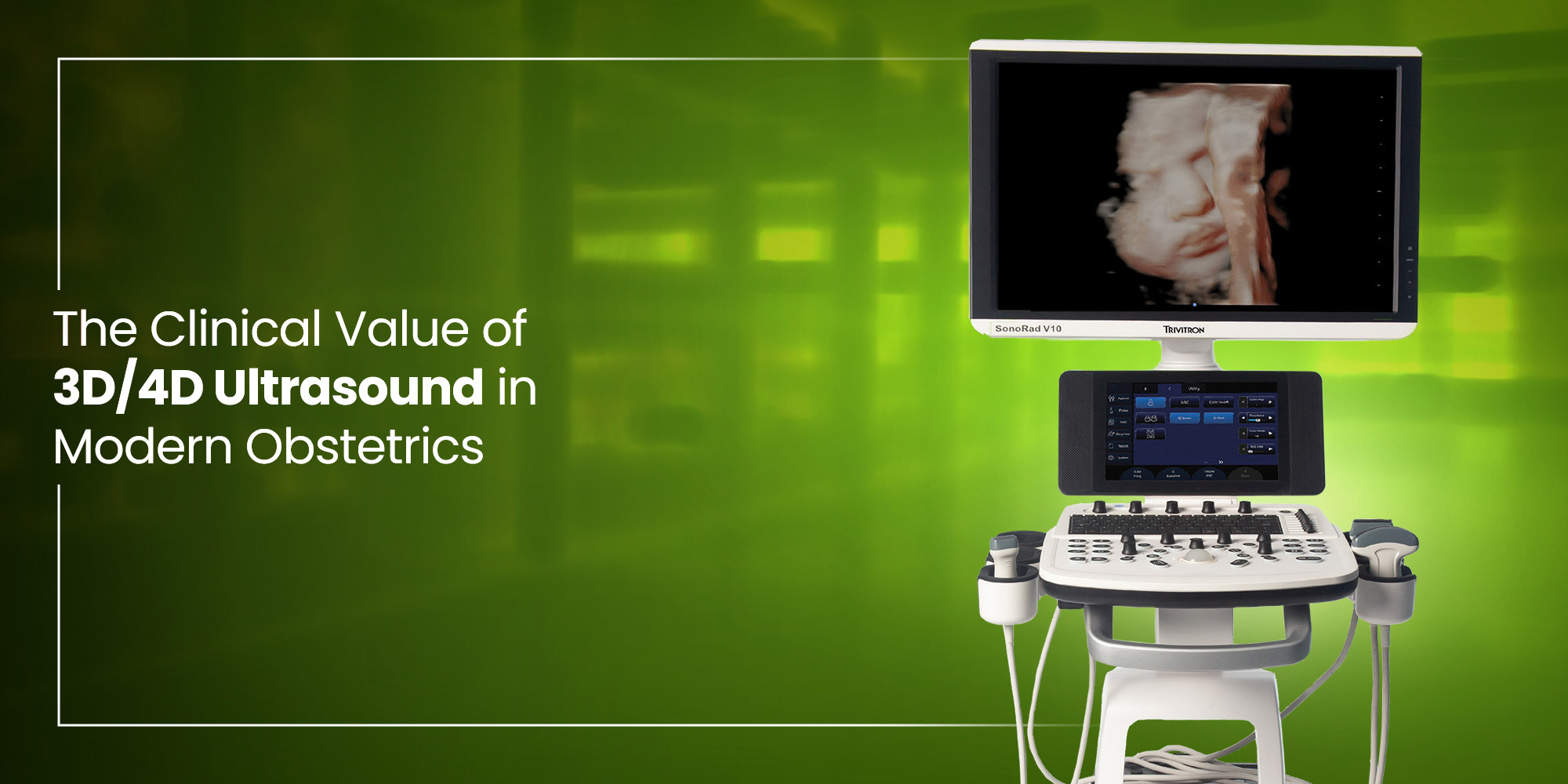
The Clinical Value of 3D/4D Ultrasound in Modern Obstetrics
20 Mar 2026
The Clinical Value of 3D/4D Ultrasound in Modern Obstetrics
The field of obstetrics is highly dependent on ultrasound technology. The technology not only tracks fetal heartbeats but also monitors overall maternal health. The medical field uses 2D ultrasound as its primary method for monitoring fetal development. However, 3D and 4D ultrasound systems are changing how doctors assess patients and report their findings in contemporary obstetrics.
The medical field uses volumetric imaging to replace 2D scans because it helps doctors make better diagnostic decisions, delivers clearer visual results, and provides deeper anatomical details during critical moments.
Difference Between: 2D vs 3D vs 4D Ultrasound
Traditional 2D ultrasound provides flat, cross-sectional images of fetal structures, which display two-dimensional information. The method excels at performing standard measurements while assessing fetal growth and testing organ functions.
3D ultrasound, however, reconstructs multiple 2D slices into a volumetric image, generating three-dimensional images of fetal body structures.
4D ultrasound takes this a step further by adding real-time movement to 3D imaging, allowing medical professionals to see dynamic fetal movements throughout a 3D space.
Medical institutions use spatial visualization techniques that enable doctors to better understand complex anatomical structures by shifting their focus from basic to advanced imaging methods.
Improved Detection of Congenital Anomalies
The medical field uses 3D ultrasound technology because it allows doctors to see body surfaces with exceptional detail, providing important clinical value.
Conditions such as:
- Cleft lip and palate
- Neural tube defects
- Limb abnormalities
- Facial dysmorphism
- Skeletal deformities.
The use of three-dimensional reconstruction provides better visual results for certain data sets. The multiplanar mode allows clinicians to simultaneously view the sagittal, coronal, and axial planes, enabling them to understand structural abnormalities in their entirety.
3D imaging enables doctors to verify fetal abnormalities when radiologists detect them during medical examinations.
Enhanced Evaluation of the Fetal Face and Spine
Assessing the fetal face with 2D imaging is extremely difficult because it cannot capture all details.
The combination of fetal position and acoustic shadowing creates restrictions that reduce imaging precision.
3D ultrasound technology enables users to create facial contour displays that help identify cleft lip and subtle craniofacial defects. The assessment of spinal defects through volumetric evaluation enables clinicians to examine both bone alignment and soft-tissue involvement with great detail.
The additional visual information that this method provides helps to eliminate doubts about the diagnosis.
Clinical Value in High-Risk Pregnancies
The precision of medical procedures becomes essential in high-risk obstetric cases, which include maternal diabetes, a history of congenital anomalies, and abnormal screening marker results.
3D/4D ultrasound assists in:
- Detailed cardiac assessment (in conjunction with fetal echocardiography)
- Placental localization and morphology
- Uterine anomaly evaluation
- Assessment of amniotic bands
- Volume datasets can also be stored and reanalyzed later, allowing secondary review without repeated patient exposure
- For maternal-fetal medicine specialists, this reproducibility adds significant value.
Real-Time Fetal Behavior Assessment with 4D Imaging
4D ultrasound provides a functional perspective that enhances obstetric assessment. The real-time observation of fetal movements enables us to assess three aspects.
- Limb coordination
- Facial expressions
- Swallowing movements
- Neurological activity patterns.
The field of research is still developing, with existing studies showing that 4D imaging-based behavioral assessment can help detect neurological problems at early stages.
Fetal testing methods currently use established neurological tests, but this new method yields interesting results that may help assess fetal development.
Strengthening Parental Counseling and Communication
The use of 3D and 4D ultrasound technology helps doctors better communicate with patients about their condition than standard clinical diagnosis methods.
The detailed fetal image helps parents better understand the diagnosis. Volumetric imaging visualizes detected anomalies, helping doctors make informed decisions.
The images help mothers bond with their babies during normal pregnancies, leading to positive psychological outcomes throughout their pregnancy.
Not a Replacement, but a Complement
The 3D/4D ultrasound system maintains its original function when combined with standard 2D imaging techniques. The system complements standard 2D imaging methods.
The medical field uses 2D methods for standard biometric assessments, Doppler tests, and growth tracking. The 3D/4D ultrasound system delivers significant benefits by providing precise structural details and confirming existing abnormalities.
Specialized application of the system maximizes its effectiveness, whereas uncontrolled use reduces efficiency.
The Future of Volumetric Imaging in Obstetrics
The development of volumetric ultrasound technology advances through upgrades to transducer technology, rendering software enhancements, and AI-powered image reconstruction.
Doctors today need their work to present accurate information while implementing early detection methods and establishing effective communication systems with patients. The development of 3D and 4D ultrasound technology enables these two methods to work together, delivering diagnostic accuracy while preserving essential patient information.