

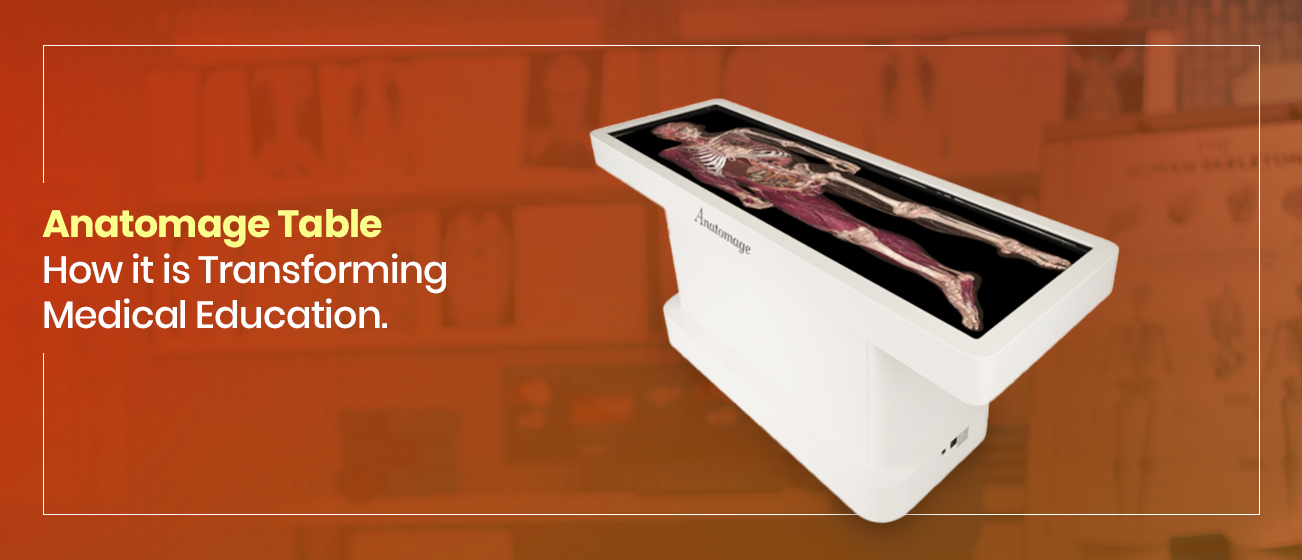
Anatomage Table – How It Is Transforming Medical Education
10 Jun 2026
Medical education has always relied on a deep understanding of human anatomy. For decades, cadaver-based dissection has been the cornerstone of this learning. But today, technology is redefining how students explore the human body. At the centre of this transformation is the Anatomage table, an advanced tool that is changing the way anatomy is taught and understood.
As institutions move toward more interactive and immersive learning, the rise of advanced anatomy learning tools is helping bridge the gap between theory and real-world application.
What is the Anatomage Table?
The Anatomage table is a life-sized, touchscreen-based virtual dissection table that allows students to explore the human body in a highly detailed, digital format. Unlike traditional methods, it provides a three-dimensional view of anatomical structures, enabling users to visualise and interact with the body layer by layer.
From skeletal systems to organs, tissues, and even pathological conditions, the table offers a comprehensive and dynamic learning experience.
How Does the Anatomage Table Work?
Understanding how Anatomage table works helps highlight why it is becoming an essential part of modern medical education.
The system uses high-resolution imaging data from real human bodies to create detailed 3D models. These models can be:
- Rotated and zoomed
- Sliced in multiple planes (axial, sagittal, coronal)
- Viewed layer by layer
Students can simulate dissections without physical limitations, making it easier to study complex anatomical relationships. The interactive touchscreen interface allows for intuitive navigation, making the learning process more engaging and efficient.
Virtual Anatomy vs Traditional Dissection
One of the most common discussions in medical education today is virtual anatomy vs traditional dissection. While both methods have their value, the Anatomage Table introduces a new dimension to learning.
Traditional Dissection
- Hands-on experience with real human tissue
- Develops tactile understanding
- Limited availability of cadavers
- Time-consuming and resource-intensive
Virtual Dissection Table
- Unlimited access to anatomical models
- No ethical or preservation concerns
- Ability to repeat and revise concepts easily
- Clean, safe, and time-efficient
Rather than replacing traditional methods entirely, many institutions now use a hybrid approach, combining cadaver-based learning with digital tools for a more comprehensive understanding.
Key Benefits of Anatomage Table in Medical Education
The growing adoption of this technology is driven by the clear benefits of Anatomage table in medical education.
1. Enhanced Visual Learning
The ability to view structures in 3D improves spatial understanding, which is crucial in anatomy.
2. Interactive and Engaging Experience
Students are no longer passive learners. They can actively explore, manipulate, and analyse anatomical structures.
3. Repetition Without Limitations
Unlike cadaver-based learning, virtual dissection can be repeated multiple times, allowing students to revisit concepts as needed.
4. Integration of Clinical Cases
Many systems include pathological data, helping students connect anatomy with clinical conditions.
5. Time and Resource Efficiency
With no need for preservation, storage, or specialised lab conditions, institutions can optimise resources.
Improving Clinical Understanding
One of the most significant advantages of using a virtual dissection table is its ability to connect anatomy with clinical practice.
Students can:
- Study disease progression visually
- Understand surgical approaches
- Correlate anatomical structures with diagnostic imaging
This integration helps bridge the gap between classroom learning and real-world medical scenarios.
A Safer and More Accessible Learning Environment
Traditional dissection labs require strict safety protocols, specialised infrastructure, and trained supervision. In contrast, the Anatomage table offers a safer and more accessible alternative.
It eliminates:
- Exposure to chemicals like formalin
- Risk of infection
- Ethical concerns related to cadaver use
This makes it particularly valuable for institutions with limited resources or those looking to modernise their teaching approach.
Supporting Modern Medical Curriculum
Medical education is evolving to include technology-driven learning methods. The introduction of advanced anatomy learning tools like the Anatomage Table aligns with this shift.
It supports:
- Digital learning environments
- Simulation-based education
- Collaborative and group learning
Students can work together around the table, discuss findings, and learn in a more interactive setting.
The Role of Technology in Future Learning
The integration of digital tools in education is no longer optional, it’s essential. As healthcare becomes more technology-driven, students must be trained using tools that reflect real-world advancements.
The Anatomage table is not just a teaching aid; it is a step toward the future of medical education. With continuous improvements in imaging, data integration, and user interface, these systems will only become more powerful and widely adopted.
Challenges and Considerations
While the benefits are significant, institutions must also consider certain factors:
- Initial investment costs
- Training for faculty
- Balancing digital and traditional methods
However, the long-term advantages in terms of learning outcomes and resource efficiency often outweigh these challenges.
Conclusion
The Anatomage table is transforming medical education by making anatomy more visual, interactive, and accessible. By combining the depth of traditional learning with the power of digital technology, it offers a more comprehensive approach to understanding the human body.
As the debate around virtual anatomy vs traditional dissection continues, one thing is clear, technology is not replacing education; it is enhancing it.
For students and institutions alike, embracing tools like the virtual dissection table means stepping into a future where learning is not just about memorisation, but about true understanding.
Frequently Asked Questions (FAQs)
1. Is the Anatomage Table a replacement for cadaver dissection?
It is not a complete replacement but serves as a powerful complementary tool that enhances understanding alongside traditional methods.
2. Can students use the Anatomage Table for self-learning?
Yes, it allows students to explore anatomical structures independently, making it ideal for self-paced learning.
3. Does the table include real patient data?
It uses high-resolution imaging data from real human bodies, offering realistic and detailed anatomical models.
4. Is it suitable for all medical courses?
Yes, it is widely used in medical, dental, nursing, and allied health education.
5. What makes it different from other anatomy software?
Its life-sized display, interactive dissection capability, and high level of detail set it apart from standard digital tools.