


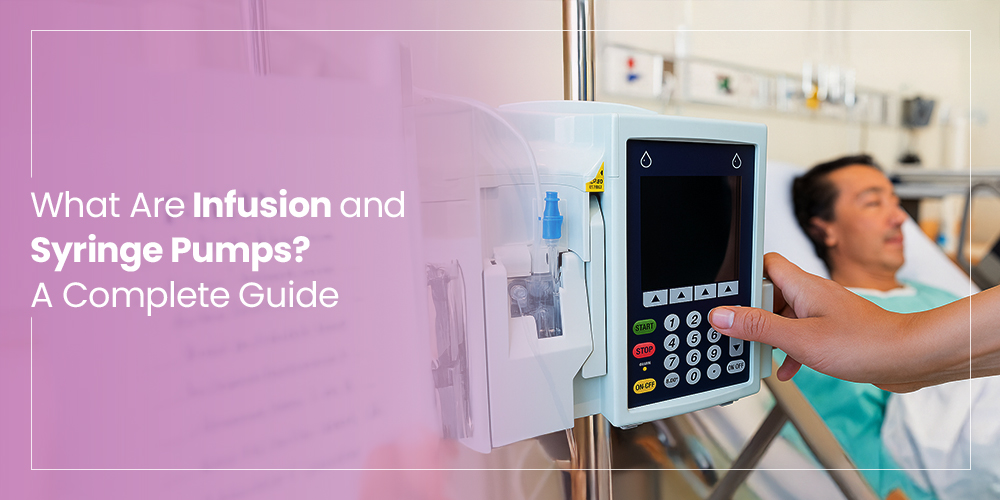
In the world of modern healthcare, precision can often make the difference between recovery and risk. Whether it’s delivering life-saving medication, administering nutrition, or maintaining fluid balance, hospitals rely on advanced medical devices to ensure every patient gets the right treatment at the right time. Among these, infusion pumps and syringe pumps play a quiet but critical role in patient care.
While these devices may not always be in the spotlight, their importance in intensive care units (ICUs), operating theatres, and general wards cannot be overstated. This guide walks you through what they are, how they work, their differences, and why they are indispensable in healthcare today.
What are Infusion Pumps?
An infusion pump is a medical device that delivers fluids such as medications, nutrients, or saline solutions into a patient’s body in controlled amounts. Unlike gravity-based drips, infusion pumps provide accuracy and consistency, which is especially crucial for critically ill patients.
Infusion Pump Working Principle:
At its core, an infusion pump uses a mechanism to push fluid through tubing into a patient’s intravenous (IV) line. The device is programmed with a specific rate (e.g., milliliters per hour) and volume to be infused. The pump then continuously monitors the flow to ensure there are no interruptions or risks, such as air bubbles or occlusions. This ensures that the therapy is delivered exactly as prescribed, without human error or fluctuations in flow rate.
Types of Infusion Pumps
Hospitals use different types of infusion pumps depending on the patient’s needs:
- Volumetric Pumps: Deliver large volumes of fluids over a set time, suitable for hydration or nutritional therapy.
- Ambulatory Pumps: Portable devices allowing patients to receive medication while moving around.
- Enteral Pumps: Designed to deliver liquid nutrition directly into the digestive tract.
- Patient-Controlled Analgesia (PCA) Pumps: Allow patients to self-administer small doses of pain medication under preset safety limits.
Knowing the types of infusion pumps helps medical teams select the right one for each clinical situation, ensuring both safety and efficiency.
Syringe Pumps – Precision in Small Volumes
A syringe pump is a type of infusion device designed to deliver very small volumes of fluid with extreme accuracy. Instead of a large IV bag, a syringe filled with medication is mounted on the pump. The device then pushes the syringe plunger at a controlled rate to administer the fluid.
Syringe Pump Uses in Hospitals:
- Administering potent drugs like insulin, adrenaline, or chemotherapy agents.
- Delivering anaesthetics during surgery.
- Providing neonatal nutrition or medication where minute volumes are critical.
- Continuous administration of cardiac drugs in ICUs.
Because they are ideal for medications that require high precision in small doses, syringe pumps are considered vital in critical care settings. When hospitals look for the best syringe pump for ICU environments, they prioritise features like advanced programming, accuracy, safety alarms, and ease of cleaning.
Infusion vs Syringe Pump – Key Differences
Although both devices deliver fluids into the body in a controlled manner, they differ in several ways. Here’s a closer look at each key difference:
1. Volume Delivered
An infusion pump is designed to deliver larger volumes of fluids, often ranging from 100 ml to over a litre, over an extended period. This makes it ideal for hydration, nutrition therapy, or continuous medication infusions. A syringe pump, however, delivers much smaller volumes with extreme precision, making it perfect for potent drugs that require micro-dosing.
2. Typical Use
Infusion pumps are the go-to for treatments where a steady supply of fluids is needed over hours or days, such as IV drips, pain management, or chemotherapy. Syringe pumps are used when high precision is required in critical care settings, for example, administering anaesthesia in surgery or delivering drugs to premature infants.
3. Fluid Source
Infusion pumps draw fluid from an IV bag or bottle, which connects to the patient via a drip set. Syringe pumps, as the name suggests, use a pre-filled syringe as the fluid source, with the pump controlling the plunger movement to release the medication.
4. Accuracy Level
Both pumps are accurate, but syringe pumps are built for ultra-precision in low-volume delivery. They can control dosage down to fractions of a millilitre, making them indispensable when even the smallest error could be harmful.
5. Mobility and Portability
Infusion pumps are often larger and stationed at a patient’s bedside, especially in ICUs or hospital wards. Syringe pumps are generally more compact and can be used in settings that require mobility, such as during patient transfers or in emergencies.
In essence, infusion pumps are the reliable workhorses for bulk fluid delivery, while syringe pumps are the meticulous specialists for delivering exact doses in sensitive scenarios.
Applications in Modern Healthcare
Both pumps are widely used across various departments in hospitals:
- Intensive Care Units (ICUs): Managing life-support medications with high accuracy.
- Operating Theatres: Delivering anesthesia or sedatives during surgery.
- Emergency Rooms: Rapid but controlled delivery of life-saving drugs.
- Neonatal ICUs: Administering delicate doses to premature babies.
- Oncology Wards: Delivering chemotherapy agents with precision.
These infusion and syringe pump applications help reduce human error, improve patient safety, and allow healthcare providers to focus on patient monitoring rather than manual fluid administration.
Frequently Asked Questions (FAQs)
1. What is an infusion pump, and how does it work?
An infusion pump is a device that delivers fluids like medications or nutrients into a patient’s bloodstream at a controlled rate. It works by using a programmed mechanism to push fluids through an IV line, ensuring precise and consistent delivery.
2. What is the difference between an infusion and a syringe pump?
The main difference lies in volume and precision. Infusion pumps handle larger fluid volumes from an IV bag, while syringe pumps deliver smaller, highly accurate doses from a syringe.
3. What are the types of infusion pumps used in hospitals?
Common types include volumetric pumps, ambulatory pumps, enteral pumps, and PCA pumps, each serving specific medical needs.
4. How does a syringe pump work?
A syringe pump operates by mechanically pushing the plunger of a syringe at a controlled rate, delivering a set amount of fluid into the patient’s body.
5. What are the infusion and syringe pump applications?
They are used for administering medications, fluids, and nutrition in ICUs, operating rooms, neonatal care, oncology wards, and emergencies.